




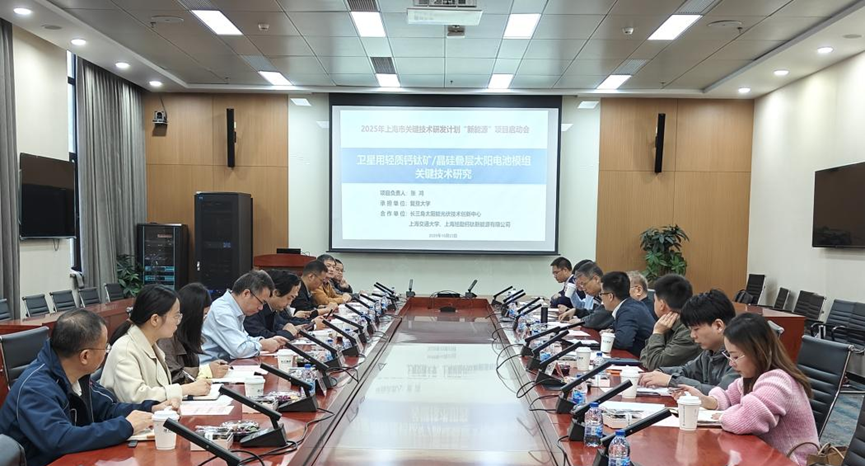
On October 23rd, the 2025 Shanghai Key Technology R&D Program "New Energy" Special Project - "Key Technology Research on Lightweight Perovskite/Crystalline Silicon Tandem Solar Cell Modules for Satellites" was officially launched at the State Key Laboratory of Photovoltaic Science and Technology, Fudan University. Leaders from the Shanghai Municipal Science and Technology Commission, project initiation review experts, and representatives from participating organizations including Fudan University, Shanghai Jiao Tong University, the Yangtze River Delta Solar Photovoltaic Technology Innovation Center (hereinafter referred to as "YIST"), and Shanghai Xuli Perovskite New Energy Co., Ltd. attended the launch ceremony. As one of the project undertakers, YIST, leveraging its technological accumulation in ultra-thin and high-efficiency crystalline silicon bottom cells, has become a core force driving the integrated innovation of "Aerospace + Photovoltaics".
YIST Takes on Core Research
Ultra-Thin Crystalline Silicon Technology Breaks Through Space Energy Bottlenecks
At the launch meeting, Zhang Hong, Director of the Institute of Optoelectronics at Fudan University and the project leader, clearly pointed out that the research and development of lightweight perovskite/crystalline silicon tandem solar cell modules for satellites faces three core challenges: weight control, conversion efficiency, and space environment tolerance. The research topic "Study on Ultra-Thin and High-Efficiency Crystalline Silicon Bottom Cells" undertaken by YIST is one of the key solutions to these problems.
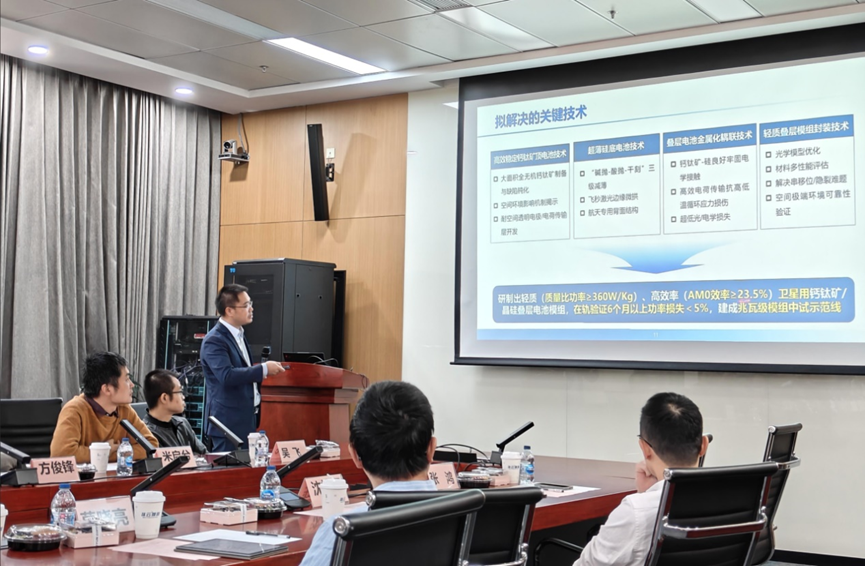
Behind these core indicators lies YIST's years of accumulated technological strength. After three years of construction, the center has built a domestically leading R&D platform for space crystalline silicon solar cells and solar arrays, equipped with comprehensive R&D conditions and capabilities for space crystalline silicon solar cells and solar arrays. It possesses a full-chain R&D capability ranging from material preparation and cell processing to array integration, laying the foundation for the large-scale production of space crystalline silicon solar cells and solar arrays.
A Technological Bridge for Cross-Border Integration
From Ground Photovoltaics to Space Energy
The cross-border integration of "Aerospace + Photovoltaics" is by no means a simple technological transplantation. The harsh space environment, characterized by strong radiation and extreme temperature differences, imposes stringent requirements on the reliability of solar cells. With its profound accumulation in space crystalline silicon solar cells, YIST has emerged as a crucial bridge connecting ground photovoltaic technologies with aerospace energy demands. Over the past three years, YIST's Special Solar Cell Team has completed over 5,000 hours of space environment simulation tests and 2 years of on-orbit testing. From proton irradiation to thermal cycle shock, a comprehensive space environment adaptability evaluation system has been established, which will provide important support for the space application of perovskite/crystalline silicon tandem cells.
The Tackling Team is Confident
Ensuring On-Time Project Acceptance
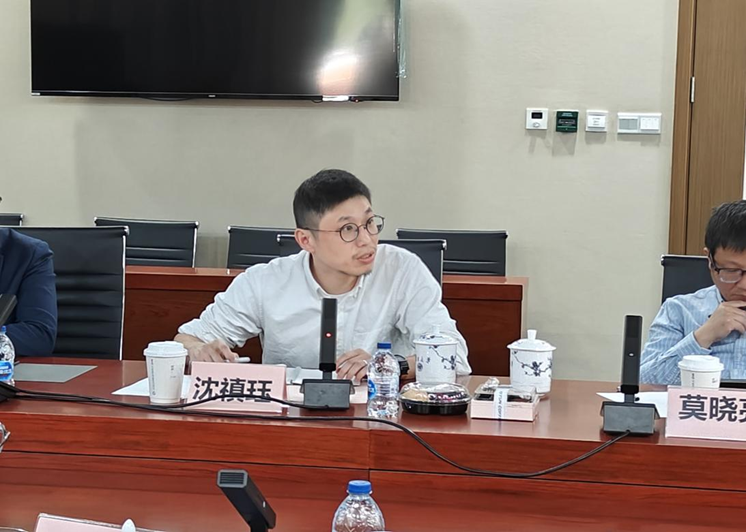
Faced with the arduous R&D tasks, YIST has formed a tackling team consisting of multidisciplinary experts in materials, devices, structures, and other fields. "A detailed R&D roadmap has been formulated, to be carried out in three phases over the next 18 months. The first phase will complete laboratory verification of ultra-thin crystalline silicon bottom cells, the second phase will achieve integration of the perovskite/crystalline silicon tandem structure, and the third phase will conduct space environment adaptability testing," emphasized Shen Zhenjue, Deputy Director of YIST. "The research team will overcome difficulties to ensure the smooth acceptance of the project. Not only will we ensure the project is accepted on schedule, but we will also develop a batch of core technologies with independent intellectual property rights to promote the leapfrog development of China's satellite energy systems."
Academician Chu Junhao delivered a concluding speech at the launch meeting. He highly affirmed the significant role of the project in promoting the development of related fields, and emphasized that all participating organizations must maintain a "sense of anxiety", make early arrangements, and, under the guidance of the Shanghai Municipal Science and Technology Commission, strictly advance the project as planned, concentrate efforts to tackle key problems, and strive to contribute to scientific research, core technologies, and engineering applications